News
-
This is a note from the openPetition editorial team:
Petitions that do not meet our quality standards must be revised by the initiator. Petitions undergoing revision will not be publicly listed.
Petition addressed to: News Media Executives
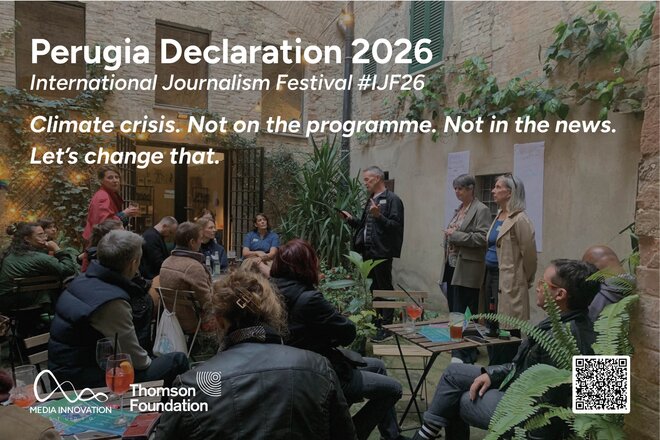
Perugia Declaration 2026
This evening (15 April 2026), as part of the Unofficial Green Room conversation in Perugia on the sidelines of the 20th International Journalism Festival, we invite those in the room — and those working across journalism more broadly — to commit to a shared starting point:
That the environmental crisis must not be treated as an optional topic or a reactive story but covered with the consistency, depth, and accountability it demands.
And that, as organisations and individuals, we must also begin to align what we report with how we operate — recognising our own environmental impact, taking responsibility for it, and where we can make a positive difference.
Preamble
In April 2026, in Perugia, the Media Innovation Studio at the University of Lancashire convened the Unofficial Green Room alongside the 20th International Journalism Festival, co-hosted with the Thomson Foundation and the University of Helsinki. As part of the Sustainable Innovation and Leadership Accelerator (SILA), the conversation brought together those asking what more journalism can do — and those interested in supporting real progress — to focus on action
The discussion centred on three simple questions: What’s blocking us from reporting the climate crisis as it deserves? Who’s getting it right and what are they doing differently? And what are we not doing that we could start tomorrow? The conclusion was clear: we don’t have a knowledge gap on environmental issues — we have a priority gap. This document reflects that shared starting point and will be taken forward through SILA’s work across insights, education and training, and public, policy and scholarly engagement.
Why this matters
The challenge is not understanding the environmental crisis.
It is overcoming the newsroom priorities, cultural framing, and political pressures that continue to push it down the agenda.
Five Principles for Getting the Environmental Crisis onto the News Agenda
1. The environment is a news priority, not a specialist interest
The defining story of our time must shape editorial judgement across all desks — not sit in a silo.
2. Relevance is how urgency reaches audiences
Environmental stories gain traction when they connect to people’s lives — their health, jobs, homes, and communities.
3. The environment belongs everywhere in the newsroom
Politics, business, culture, sport, and local reporting all carry environmental dimensions.
Treat it as a lens, not a beat.
4. Consistency builds authority
One-off stories are easy to ignore.
Sustained, explanatory reporting based on a systemic approach builds trust, credibility, and impact.
5. Change is collective
Shifting the agenda requires shared commitment — across journalists, editors, producers, and organisations.
What this means in practice
An invitation
We invite those participating in this conversation to sign, test, and take forward these principles — within your own organisations and in collaboration with others.
Convened by the Media Innovation Studio, University of Lancashire, UK, and the Thomson Foundation, working group partners in the Sustainable Innovation & Leadership Accelerator (SILA) initiative.
Petition started:
28 May 2026
Collection ends:
11/27/2026
Region:
United Kingdom
Topic:
Media
Supporters argue the public cares far more about the environmental crisis than many news organisations recognise. Journalism’s role is not only to report on climate and sustainability, but also to examine its own practices, partnerships, technologies, and environmental footprint. “Walking the talk” is therefore seen not as activism, but as an issue of transparency, trust, resilience, and leadership
Critics argue that the reality inside news organisations is more complicated. Economic pressures, shrinking revenues, platform dependency, and audience fragmentation force many editors to prioritise short-term survival. Environmental issues are complex, politically contested, and difficult to sustain in daily news cycles. Some also fear that linking reporting with organisational sustainability risks blurs the line between journalism and advocacy.
Climate change is a matter of survival for humanity. Failing to explain the crisis and its impacts on people's everyday lives is a fundamental failure of journalism. At brandmelder.org, we share the goals of this petition and are working to strengthen climate journalism, context, and public understanding.
The Importance of Environmental Journalism: Introduction. Environmental journalism is a cornerstone in building public awareness of pressing environmental issues and plays a vital role in shaping public opinion and guiding policies towards achieving sustainable development. In light of the increasing environmental challenges facing the world, such as climate change, water scarcity, and pollution, the importance of environmental media as an effective tool for highlighting these issues and offering possible solutions is paramount [1][2]. This article aims to review the pivotal importance of environmental journalism, its role in raising awareness, and addressing the challenges it faces, with a focus on the Arab context. The Role of Environmental Journalism in Raising Awareness and Protecting the Environment. Environmental journalism undertakes multiple tasks that contribute to protecting the environment and raising awareness about it. Among the most prominent of these roles are: Spreading Awareness of Environmental Issues. Environmental journalism simplifies complex scientific information related to the environment and presents it to the public in an understandable and engaging way. This contributes to increasing individuals' understanding of environmental challenges and their impact on their lives and health [3]. For example, journalistic reports can explain the dangers of plastic pollution or the importance of preserving biodiversity.
You have your own website, a blog or an entire web portal? Become an advocate and multiplier for this petition. We have the banners, widgets and API (interface) to integrate on your pages. To the tools



To understand new thi6