
10/15/2026, 11:33
I changed the number of signatures and date of collection
New deadline: 07/17/2027
Signatures at the time of the change: 88
10/15/2026, 11:33
I changed the number of signatures and date of collection
New deadline: 07/17/2027
Signatures at the time of the change: 88
10/15/2026, 11:25
It's not an Act as yet, as stated in the heading. I changed he word Act to Bill.
New title: Responsible Parenthood ActBill
Signatures at the time of the change: 88
10/15/2026, 11:20
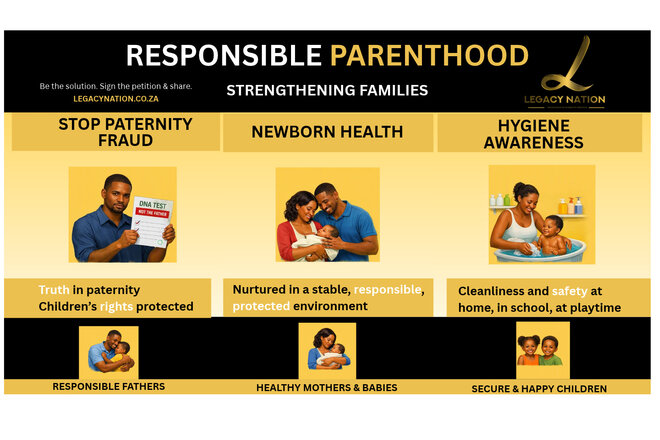
I changed the image and added more information for more clarity.
New petition description:
We call on the South African government to urgently pass the Responsible Parenthood Act.
Strengthen Southfamilies, AfricaEradicate facesthe oneeffects of thefatherlessness, highest levels of paternity fraud insave the world,babies & save our future.
Too many children grow up without identity rights, too many newborns die from preventable infections, and too many fathersfamilies failcollapse under the weight of unresolved disputes and untreated trauma. The Responsible Parenthood Bill is more than legislation. It is a movement to takestrengthen responsibilityfamilies for their children. This Act is necessary toand protect men from fraudulent paternity, women from men who escape responsibility due to uncertainty, and children from trauma and instability. It demands accountability from women, whose deception in cases of paternity fraud causes lifelong, irreparable damage, most especially to the children involved. By holding both men and women to equal standards of responsibility, the Act ensures fairness, stability, and protection for families across the nation.children.
ForURGENT over two decades, I've worked closely with youth across South Africa. I’ve seen firsthand the devastating effects of broken family structures. As a parent and citizen, I cannot ignore the damage caused by paternity fraud and absent fatherhood in South Africa. This issue is deeply personal because it strikes at the heart of family stability, trust, and the wellbeing of children. When boys grow up without truth, stability, or responsible fathers, they often carry that brokenness into adulthood. Instead of strong family and community leaders, we are left with males wounded by their childhood, repeating cycles of abandonment, deception, and instability that repeats through generations. The cycle ends with your signature. Join Legacy Nation in calling for the Responsible Parenthood Act. Sign now to help end generational cycles of neglect and restore truth, fairness, and accountability in South African families.REALITIES
For- men:Paternity fraudulentFraud: paternity forces them into lifelong obligations for children who are not biologically theirs. This is not just financial injustice, it is a violation of dignity and truth.For women: when men escape responsibility due to uncertainty, mothers are left carrying the full burden of care, often without support.For children: the consequences are the most devastating. They grow up with fractured identities, emotional trauma, and instability that can last a lifetime.Credible evidence shows the scale of the crisis:Only 35% of South African children live with their biological fathers, while nearly 20% live with neither parent (State of South Africa’s Fathers Report, 2024).Over+ 60% of births are registered without paternal details, leaving children vulnerablevulnerable. DNA testing in contested cases excludes alleged fathers nearly 30% of the time. Among the highest rates globally according to fraud,Stats SA birth registration data and South African DNA case studies published in academic journals.
- Newborn Health: CHAMPS South Africa study (Wits University, published in The Lancet Infectious Diseases, 2026) found infections involved in 44% of neonatal deaths, with Soweto reporting 16 deaths per 1,000 live births, above the national average. Over 80% of these infection‑related deaths were deemed preventable through improved hygiene, infection control, and maternal care.
- Hygiene Awareness: The National Institute for Communicable Diseases (NICD) surveillance reports confirm widespread circulation of respiratory viruses, including influenza, RSV, and rhinovirus. These pathogens are major contributors to illness in infants, children, the elderly, and people with compromised immune systems.
- Counselling: The South African Federation for Mental Health (SAFMH) and South African Depression and Anxiety Group (SADAG) classify male suicide as a national crisis, with +14,000 suicides annually, 11,200 of them men. Access to counselling remains below 5% due to systemic shortages and stigma.
- Insurance Crime: While South Africa lacks consolidated national data on fraudulent maintenance claims, case law (Rule 43 disputes) shows systemic abuse. The South African Insurance Crime Bureau (SAICB) Annual Report 2023 recorded 13,074 fraudulent insurance claims costing R175.9 million, illustrating how misrepresentation linked to parentage and maintenance disputes drains regulated systems.
The Bill proposes practical solutions. Civil remedies for misrepresentation, maintenance until the biological father is identified, clinic‑based counselling expanded through psychology graduates, empowerment programs for men and women, and national hygiene protocols to protect newborns, children, the elderly and those with compromised immune systems.
By passing this Bill, South Africa will:
This is our chance to write South Africa,Africa 2021).Researchinto linkshistory fatheras absencethe tonation higherthat riskspioneered ofresponsible poverty,parenthood. poorEvery educationalsignature outcomes,is a step toward protecting children, restoring families, and emotionalsetting traumaa thatprecedent continuefor acrossAfrica generationsand (HSRCthe studiesworld.
Sign onnow family— structure,because 2023).every child deserves identity, protection, and hope.
08/14/2026, 15:14
Yes, we live in a historically patriarchal, oppressive world. Every day we fight those injustices, so why do they still exist? Patriarchy isn’t in our DNA. It’s not destiny. So why hasn’t it changed? Perhaps because society fuels the sins of the father instead of stopping them.
Girls are invited to empowerment programs, taught to rise and resist patriarchy. Boys are excluded, & left without guidance on dismantling it within themselves. The unspoken message, “You're not worthy of time, love, or investment.” While girls are nurtured, boys are expected to have it figured out alone.
This exclusion breeds resentment, confusion, and self‑doubt. Boys internalize the idea that they are flawed or undeserving, masking pain with bravado or aggression. Band‑aid solutions abound, but the wound remains. A lack of affirmation and mentorship.
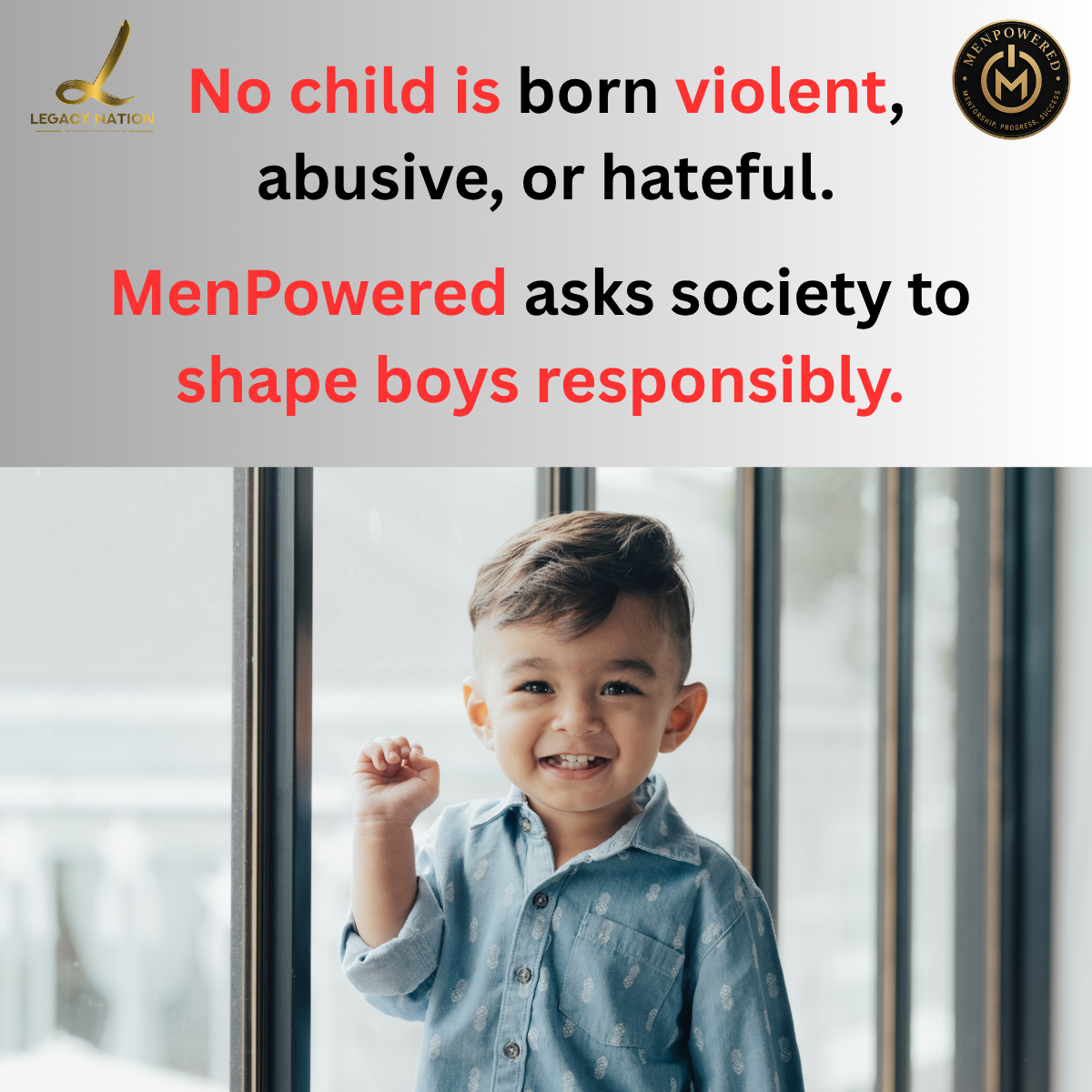
A seed, at its purest, carries potential. Fragile yet powerful, like a baby boy, innocent, unshaped, unscarred. He's not born violent. What he becomes depends on the soil, water & light. Poisoned soil of patriarchy and neglect bends him toward destruction. But rich soil of mentorship, water of compassion, and light of accountability grow him into a man who heals, not harms.
That is MenPowered’s mission. Mentorship, accountability, and a call for the Responsible Parenthood Bill to strengthen families and protect children. Why Men’s Day? To honor men who resisted injustice, balancing Women’s Day’s tribute to women who resisted oppression. Together, they form a liberation narrative of unity, not discord.
What message do we give the boy who helps his gran, loves his mum, and protects his sister? As we strip away patriarchy and toxic masculinity, what traits will define manhood?
Does MenPowered have all the answers? No! But we call S. Africa to unite in creating solutions. If they work, we celebrate. If not, we try again. We never give up on the potential within every boy because of systems they were born into. Change will never come if we only judge and complain, it comes when we act.
07/31/2026
musamathonsi.wordpress.com/2026/07/31/npo-legacy-nation-launch-menpowered-campaign/
07/17/2026, 14:47
Introduction
South Africa heartbreakingly has one of the highest rates of paternity fraud globally. Over 60% of births are registered without paternal details, and contested DNA cases show exclusion rates of up to 30%. This devastates men emotionally and financially, while leaving children traumatized.
Countries like Nigeria have boldly attempted mandatory DNA testing, but faced backlash for being invasive and destabilizing. The Responsible Parenthood Act™ offers South Africa a more holistic solution that protects men, women, and children from the devastating consequences of paternity misrepresentation. This Act strengthens family integrity by combining legal accountability, counselling, and protocols for permanent positive change.
The Problem:
Women fraudulently misrepresent men as fathers, often without remorse. This deceit devastates men emotionally and financially, while leaving children embarrassed and traumatized. Global case studies from South Africa, Denmark, Nigeria, and Ghana reveal murder‑suicides and suicides tied directly to paternity fraud. Children bonded to non‑biological fathers suffer identity crises and abandonment when the truth emerges. Meanwhile, the lack of accountability fuels promiscuous and risky sexual behavior, increasing HIV transmission and unwanted pregnancies.
International Comparison
Nigeria: 30% misattributed paternity. Proposals for mandatory DNA testing at birth were rejected as invasive and destabilizing.
Jamaica: 34.6% misattributed paternity.
UK and Canada: Lower rates (1–3%), but contested cases still show 10–15% exclusions.
Tragedies Linked to Paternity Fraud
Mamelodi, 2025: Police constable murder‑suicide after discovering his child was fathered by his brother.
Durban, 2024: Mlondi Cele killed his girlfriend and their 3‑year‑old son after suspecting infidelity.
Mpumalanga, 2026: Miner Mfanimpela Dlamini committed suicide after DNA tests excluded him as father of one child.
Denmark, 2026: Ghanaian man Benjamin Offei committed suicide after learning none of his four children were his.
Nigeria, 2023: Olanrewaju Kolawole collapsed into a coma for seven days after discovering none of his four children were his.
The Responsible Parenthood Act™: An Overview
The Act proposes a balanced framework to address paternity fraud in South Africa.
It combines:
This approach protects men from exploitation, women from abandonment, and children from trauma. It ensures continuity of care while promoting accountability and truth.
Conclusion
Paternity fraud is a silent and devastating attack on families across South Africa. The Responsible Parenthood Act™ offers a balanced, humane, and accountable solution, protecting men, women, and children while strengthening family integrity and public health.
Sign this petition to demand Parliament pass the Responsible Parenthood Act™.